The science
behind the number
on the report.
Pendulum slip testing is deceptively simple. Done badly it produces meaningless data; done correctly it stands up in court. Here is how Surface Performance Ltd, operating as UKAS Testing Laboratory No. 7933, does it.
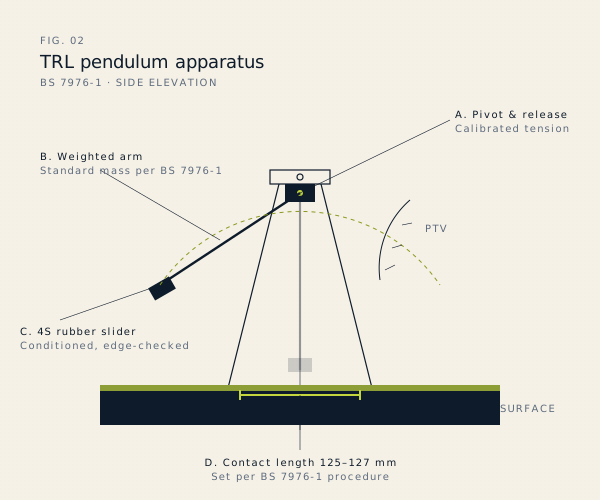
A calibrated TRL pendulum, in calibration.
The TRL pendulum (formerly the British Pendulum) is the instrument specified in BS 7976-1. It works by swinging a weighted arm carrying a rubber slider over a measured contact length on the test surface. Energy lost to friction is read on a graduated scale: the Pendulum Test Value, or PTV.
The reading is sensitive to slider hardness, slider edge condition, slider conditioning, ambient temperature, swing speed, contact length and operator technique. A pendulum used by an untrained operator with a worn slider, or measured against an arbitrary scale, produces a number — but not a defensible one.
Every pendulum we operate is calibrated annually against a reference surface set by an external UKAS-accredited calibration body. Sliders are checked to BS 7976-1 before each survey and replaced when worn beyond tolerance. The calibration record travels with the report under our UKAS Lab 7933 schedule.
BS 7976-2, applied as written.
BS 7976-2:2002+A1:2013 sets out the method of operating the pendulum and the conditions under which results are valid. It specifies five swings, the discard of the first swing as a wet-up swing, and the reporting of the mean of the remaining four. It specifies test direction — typically two perpendicular axes — and the recording of any anomalies.
In a sports hall context the standard is supplemented by guidance from the UK Slip Resistance Group (UKSRG) on test interpretation, by EN 14904 for new-build surfaces, and where relevant by ITF, World Rugby or governing-body criteria for the sport played on the surface.
A pendulum reading reported without reference to BS 7976-2 — or worse, taken on a single dry swing in a single direction — is not a slip test in any meaningful sense. The number is a souvenir, not evidence.
Dry, wet, and the conditions that actually cause the slip.
| Condition | Slider | What it tells you | When required |
|---|---|---|---|
| Dry | 4S or TRL | Baseline grip in normal play conditions. The reading most sports halls operate at most of the time. | Always. |
| Wet (potable water) | 4S | How the surface behaves when contaminated with water — sweat, condensation, leaked drinks, mopping residue. The reading that drives most claims. | Always. |
| Cleaning chemical residue | 4S | Whether the cleaning regime itself is reducing slip resistance. Common cause of marginal-pass timber floors. | Where contamination history exists or post-incident. |
| Sports-specific contamination | 4S | Rosin, chalk, glove tack residue. Surfaces used for handball, gymnastics, certain dance forms. | Sport-led. |
The second number that explains the first.
A pendulum reading without a roughness reading is half a story. Two surfaces can return identical PTV in dry conditions and behave completely differently when wet — because micro-roughness governs how a water film breaks up under load.
We measure surface micro-roughness (Rz) using a calibrated stylus profilometer on every survey. The reading correlates with the wet PTV and is reported alongside it. For sports hall surfaces, Rz tends to fall in the 8–30 µm band; below 10 µm in wet conditions is a known risk factor.
| Rz (µm) | Indication |
|---|---|
| < 10 | Smooth. Wet slip risk likely elevated. |
| 10 – 20 | Typical conditioned timber. Acceptable when dry; inspect wet PTV. |
| 20 – 30 | Textured polyurethane / multi-use vinyl. Strong wet performance. |
| > 30 | Coarse texture. Excellent grip, may compromise glide for some sports. |
For new-build, refurbishment, and product certification.
EN 14904 is the European harmonised standard for indoor sports surfaces — “Surfaces for sports areas — Specification for indoor surfaces for multi-sports use”. It is the standard a new sports hall floor must demonstrate compliance against on installation. It is also the standard a manufacturer must hold test data against to specify their product.
EN 14904 specifies a sliding friction coefficient — measured with a force-shoe rig, not the pendulum — in the range 80 to 110 µ. The standard also specifies shock absorption, vertical deformation, ball rebound, vertical ball deflection, area deformation, sliding behaviour and surface effect on rolling load. Slip resistance is one element of a multi-element conformity test.
Where an installation is being signed off against EN 14904 we test sliding friction in addition to PTV and report against both, with cross-reference to the manufacturer’s product certification.
A sports hall is not a single surface.
A standard sports hall presents at least four functional zones: high-traffic centre, marked sport-specific zones, perimeter run-off, and threshold/entry. Each behaves differently. Each is sampled.
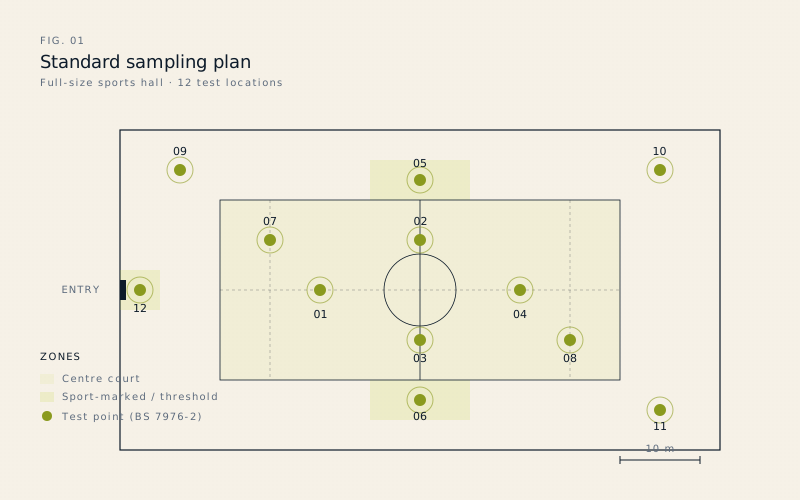
Centre court
The most heavily worn area. Where sealant has been worn through; where polish has built up; where most slip incidents occur.
Sport-marked areas
Painted lines and areas behind goals or service boxes have different surface chemistry to the surrounding floor. Tested separately.
Perimeter / run-off
Less worn, more sealant intact. Often the highest dry PTV and yet the lowest wet PTV — sealant is itself a slip risk when wet.
Threshold & entry
Where contamination is introduced — water, mud, dust. Tested specifically for the cross-contamination case that drives many claims.
A UKAS-endorsed report does specific things a non-accredited report cannot.
A UKAS-endorsed test report carries the UKAS endorsement mark and references the laboratory’s schedule of accreditation — in our case, Schedule No. 7933. The endorsement signals that the test method, equipment, training and quality-management processes have been independently audited against ISO/IEC 17025:2017. The report is admissible as expert evidence on that basis.
An unendorsed report does not carry that signal. In litigation, opposing counsel will ask whether the testing laboratory was UKAS accredited for the specific test method on the date of test. The honest answer is yes or no. There is no third option.
What our report contains
- UKAS endorsement mark and Schedule 7933 reference
- Site, surface, sport, and survey scope
- Instrument serial number, calibration date and reference
- Slider type, slider conditioning record, ambient conditions
- Photographic record of each test location
- PTV results — mean, individual swings, both directions
- Surface roughness Rz, per location
- Where applicable, EN 14904 sliding friction
- Plain-English risk assessment per location
- Recommended actions, prioritised
Ready for a defensible slip test?
Most surveys are scheduled within ten working days of quote acceptance. Post-incident attendance available within 48 hours.
Request a Quote →